




Kristina is the founder of Lockenbox & Lockenexpertin. She has been intensively involved with the topic of curly hair care since her youth, when her straight hair suddenly turned into curls.
Conditioner is a household name when it comes to hair care. However, the correct application isn't always clear, and it's easy to get lost in the seemingly endless jungle of products.
The word conditioner is derived from the English verb "to condition" and literally means "to prepare" or "to bring into the right condition" – and that's exactly what a conditioner does to your hair. In German, the word "Haarspülung" has become established.
A conditioner is neither a shampoo nor a hair treatment , but a separate care product with its own effects. Below, we'll explain the effects and application of a conditioner in more detail.
What exactly is a conditioner?
In contrast to a shampoo , whose main task is to clean the hair , a conditioner primarily has a caring and protective effect .
Even though shampoos, especially curly shampoos , have a clarifying effect on the hair, curly and wavy hair in particular benefits from an additional level of care with nourishing and protective ingredients.
There are mainly two reasons for this:
- On the one hand, the hair is particularly receptive to care products after washing because the cuticle layer of the hair is opened by a shampoo.
- On the other hand, conditioners add nourishing ingredients and - depending on the type of hair conditioner - strengthening protein back into the hair .
Furthermore, conditioners have the ability to give the hair a lot of slip, i.e. increase its slipperiness, which is especially relevant for curls, as it makes the laborious task of untangling the curls considerably easier.
Find out which conditioner is best for your curls.
pH value of shampoo vs. conditioner
While shampoo has only a minimally acidic pH value and roughens and lifts the outer cuticle layer of the hair, conditioner seals it again.
This is due to the conditioner's moderately acidic pH of 3.5 to 4. In combination with shampoo, conditioner can help balance the hair's pH and bring the hair and scalp back to the skin-neutral pH range of 4.5 to 5.5.
This has a positive effect on the appearance of your hair , as a conditioner adds shine and makes your curls soft and silky. Combining shampoo and conditioner makes a perfect team to care for and maintain the health of your curls.
Choosing a conditioner: Avoid silicones
When choosing a suitable conditioner for your curly hair, we recommend avoiding silicones . While at first glance they help lock in moisture and make your hair look healthy, unfortunately, silicones are usually insoluble in water and can only be removed with sulfate-containing shampoos.
To get rid of silicones , a harsh cleanser is necessary. Furthermore, with regular use of silicone-containing shampoos, the silicone layers build up, which can lead to severe buildup.
Silicones prevent further nutrients and moisture from reaching the hair. The artificial protective layer of silicone seals your hair, which over time causes your curls to atrophy beneath this seal.
As a result, your curls become dull and brittle. That's why silicones, for example, are a no-go when using the Curly Girl Method .
What is the benefit of a conditioner?
Conditioner supports your hair in many ways:
- It has a nourishing effect and makes hair look healthier, shinier, and silkier. The cuticle layer of the hair is smoothed, which is particularly beneficial for natural curls, as these are naturally coarser and more brittle than straight hair.
-
Conditioner is suitable for regular use after every hair wash . If you have fine hair, you should be careful to apply it to the lengths of your hair to avoid weighing it down too much.
-
Conditioner also protects hair from environmental influences such as UV rays, car exhaust fumes, salt or chlorinated water, making it more resilient. This also prevents the formation of frizz.
- A conditioner's formula makes hair soft and smooth . This makes it easier to detangle and unravel knots. Smoothing the outer cuticle layer reduces the formation of new knots.
Find out which conditioner is best for your curls.
When do I need a conditioner?
Conditioner is an essential care product, and hair of all lengths and textures benefits from its use. Without a conditioner after shampooing, the hair cuticles won't close. As a result, hair remains brittle and loses moisture faster than it should. Therefore, shampoo and conditioner work best together.
- If you are blessed with short, easy-care hair that gets a regular cut, then irregular use of conditioner is fine.
- However, regular use is highly recommended, especially for longer, curly or wavy hair . Curly hair needs care! There's a myth that you can skip the conditioner if you use a hair mask occasionally, but this isn't true!
Expert tip: Even though a hair treatment or hair mask brings intensive care ingredients into the hair, it does not replace the individual care properties of a hair conditioner .
How to use conditioner correctly: A step-by-step guide
There are a few things to keep in mind when using conditioner . Only when the conditioner's nourishing effects can fully unfold will your curls receive the optimal care boost they so crave.
1. After washing your hair, first gently squeeze the excess water out of your hair.
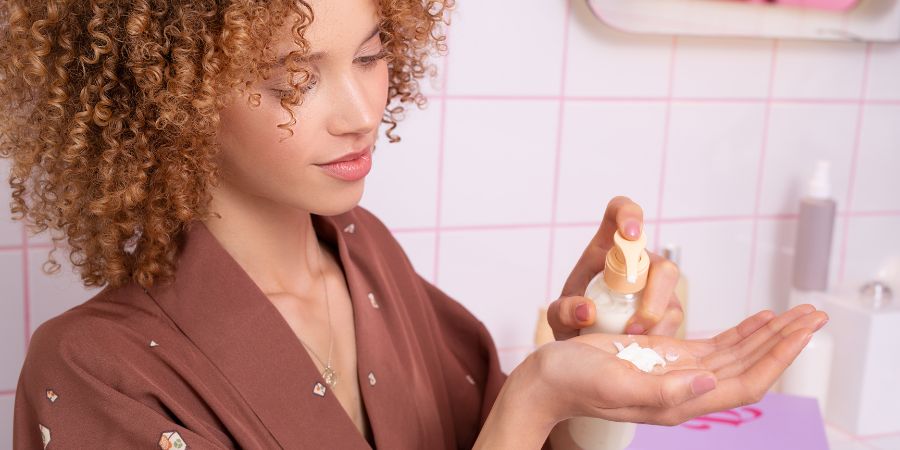
2. Apply about the size of a walnut-sized amount of conditioner—you can use a bit more if you have curly hair. Natural curls generally tolerate a lot of conditioning. Conditioner also makes the curls easier to detangle, so be generous when applying it, as this will make your hair more slippery.
3. Then, using gentle strokes, distribute the conditioner from the lengths of your hair to the ends. Depending on the product, the application time is between 1 and 3 minutes.
It's best to follow the manufacturer's instructions on the product packaging. While the conditioner is working, you can use the time to detangle your curls.
The conditioner's slip makes it much easier for your fingers, comb, or brush to glide through your hair. This is both gentle on your nerves and your beautiful curls!
4. Then simply rinse the conditioner out thoroughly with clean water.
Do you have to wash out every conditioner?
Not every conditioner needs to be rinsed out . There are also so-called leave-in conditioners , but their conditioning effects are completely different from those of a conventional rinse-out conditioner.
A leave-in conditioner is a completely different product. Leave-ins are designed to stay in your hair after washing and provide extra conditioning and definition, allowing your curls to curl perfectly.
Leave-in products also soften your curly hair and provide it with even more moisture. Another benefit is that a leave-in conditioner helps the hair keep its outer cuticle closed. This ensures shiny curls and locks in moisture.
How often should you use conditioner?
Your hair is particularly receptive to nourishing care products immediately after shampooing , but is also particularly susceptible to damage that can be caused by strenuous procedures such as towel drying or blow-drying.
As already mentioned, using shampoo opens the hair cuticle, while conditioner closes it again. Therefore, it's a good idea to use conditioner after every hair wash, as both products combined offer an optimal curly hair care routine.
Frequently asked questions about conditioners
Can I wash my hair with just conditioner?
Washing your hair with conditioner alone is possible in principle, but you should look for a " co-wash " label on your hair conditioner . These special products are less cleansing and contain fewer active ingredients than shampoo.
In the curly world , the method of washing your hair without shampoo is also known as no-poo (no shampoo). However, whether this method works for you depends largely on your curl type, hair density, and porosity.
It should not be forgotten that constant and exclusive washing with co-washes does not have sufficient cleansing power on the hair and scalp in the long term. This can very quickly lead to
- Build-up,
- oily hair
- and an uncomfortable feeling of inadequate cleaning.
That's why we recommend cleansing your hair with a good curly shampoo from time to time. In your curly hair care routine, you can, for example, alternate between a regular Curly Girl Method-approved curly shampoo and a co-wash as needed.
Can you put conditioner in dry hair?
Using conditioner on dry hair is theoretically possible, but usually not practical. Conditioner is designed to be applied to wet hair after shampooing. This is the only way to lock in moisture and close the cuticle.
If you add conditioner to dry hair, your curls can quickly look stringy and greasy . It's also likely to weigh your hair down, causing your curls to flop.
We therefore recommend using the conditioner on wet hair .
What is the difference between a rinse and a conditioner?
The difference between conditioner and rinse lies solely in the name. Conditioner is the English term for hair rinse. These days, product packaging in German often simply lists the English name "conditioner." However, it is the name for the same product.
Conclusion
Even if it takes a few extra minutes to treat your hair with conditioner, this care step is worth it and your hair will thank you with shine and bounce.
When choosing a conditioner, make sure you only use high-quality , silicone-free, Curly Girl Method-approved products and choose a conditioner that suits your hair type and texture. There are wonderful, specialized curl conditioners available these days that offer everything curly hair loves!
Ready to take your hair to the next level ? Then take our exciting curly hair quiz now! We're excited to get to know you and understand your unique hair needs and goals.
With just a few questions, we can put together your perfect curl routine . Whether your hair is slightly wavy, curly, or very curly, our curl quiz will find the right products for every hair type.
What are you waiting for? Dive into the world of the perfect curly hair look and take the quiz now!